
Every facility manager knows the tension. Budgets tighten every year, yet hygiene expectations only ever go up. Tenants notice a washroom that runs out of hand towels. Staff complain when bins overflow. Auditors flag consumables that aren’t fit for purpose. The instinct under budget pressure is to buy cheaper but cheap products used badly almost always cost more than good products used well.
The managers who consistently keep buildings clean and under budget don’t chase the lowest unit price. They manage the whole system: what they buy, how much of it they buy, who they buy it from, and how it gets used on site. If you’re sourcing cleaning supplies perth businesses rely on daily chemicals, paper, liners, PPE the savings are rarely hiding in the price list. They’re hiding in the process. This article breaks down where the real money leaks out, and the practical changes that stop it.
Where Facility Budgets Actually Leak
Before cutting anything, it pays to know where the waste really is. In most commercial buildings, consumables waste comes from a handful of predictable places.
Overuse, Not Overpricing
The biggest hidden cost in most facilities isn’t the price per litre — it’s the dose per clean. Concentrated chemicals used neat instead of diluted, half a roll of paper towel used where two sheets would do, sanitiser dispensers set to dispense triple the needed amount. A product that costs 10% more but is dispensed correctly can halve your consumption.
Wrong Product, Wrong Place
Premium 2-ply towel in a back-of-house workshop. Light-duty liners in heavy commercial bins that split and need double-bagging. General-purpose cleaner where a food-safe sanitiser is required, forcing a re-clean. Matching the product grade to the actual space is one of the fastest cost corrections available.
Fragmented Purchasing
When three different site supervisors order from three different suppliers, nobody gets volume pricing, nobody tracks usage, and stockrooms fill up with duplicates. Consolidation alone typically unlocks meaningful wholesale discounts.
Emergency Buying
Running out mid-week and sending someone to a retail shelf is the most expensive way to buy anything. Retail single-unit pricing can run two to three times trade carton pricing — and that’s before you count the staff hour lost driving there.
Five Practical Ways to Cut Consumable Costs
Here’s what the disciplined operators actually do:
- Standardise your product list. Pick one approved product per task across all sites. Fewer SKUs means better bulk pricing, simpler training, and no cupboard full of half-used alternatives.
- Switch to concentrates and refills. Buying chemicals in 5L–20L drums and decanting into labelled spray bottles cuts the per-litre cost dramatically compared with ready-to-use retail bottles.
- Control the dispense. Centre-pull towel dispensers, portion-controlled soap pumps, and correct chemical dilution systems reduce consumption without anyone noticing a drop in service.
- Set a reorder schedule, not a panic point. A standing weekly or fortnightly delivery matched to actual usage eliminates emergency purchases entirely.
- Audit quarterly. Walk the site, check what’s being used where, and prune anything that’s crept onto the order that shouldn’t be there.
None of these require capital spend. All of them compound month after month.
Why Supplier Choice Matters More Than Unit Price
A supplier is either part of your cost-control system or working against it. Across cleaning supplies wa wide, the difference between suppliers isn’t really the catalogue of most stock similar categories. The difference is the operating model behind it.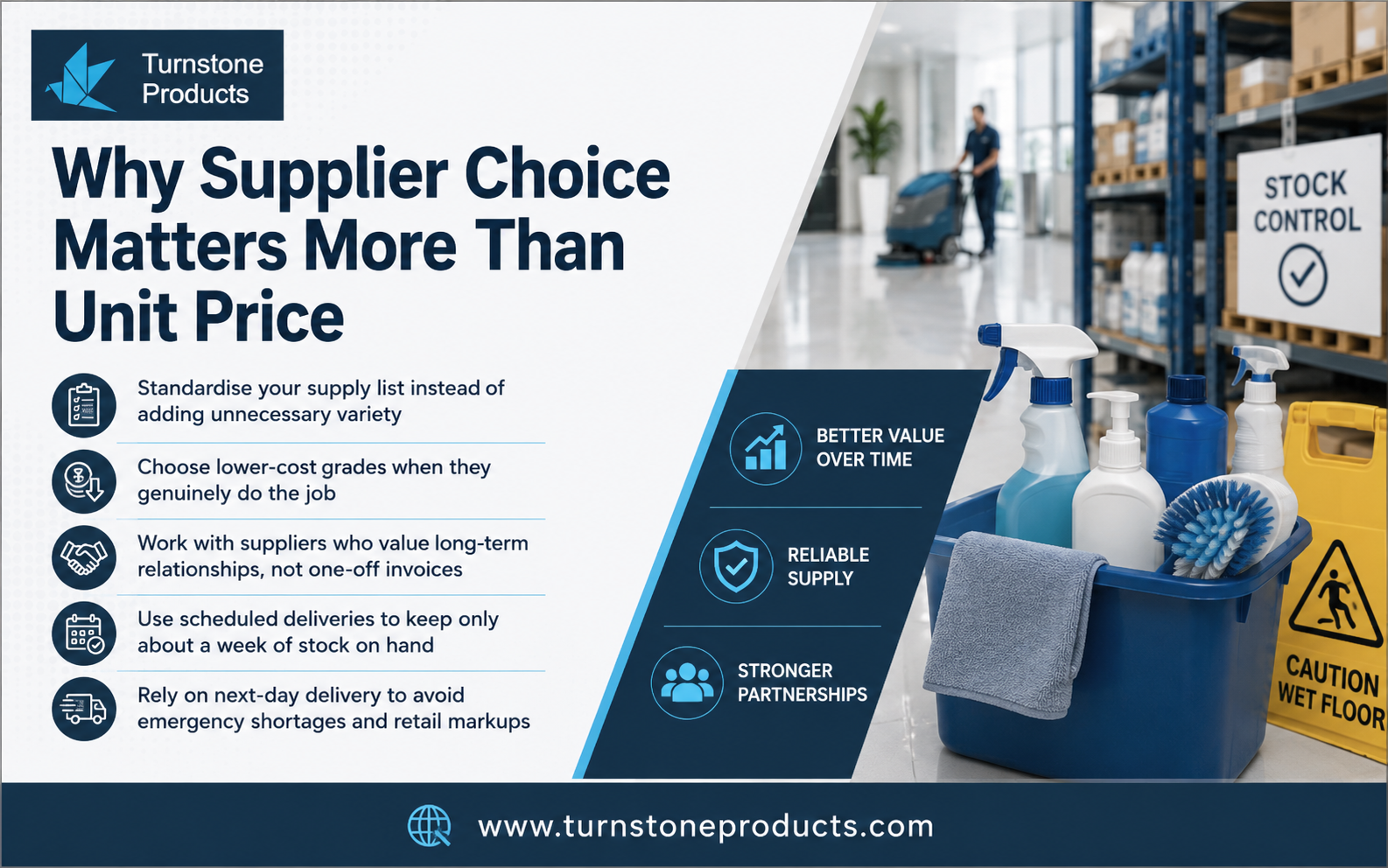
A good trade supplier will help you standardise your list rather than upsell you variety. They’ll tell you when a cheaper grade will genuinely do the job, because they’d rather keep your account for ten years than pay one invoice. They’ll deliver on a schedule that means your storeroom holds a week of stock, not a quarter’s worth of tied-up cash. And when a site runs short unexpectedly, next-day delivery means the fix costs a phone call, not a retail markup.
That’s also why quote-based trade supply often beats online carts for facilities work. A checkout can’t tell you that your dispensers take a different fold of towel, or that consolidating two products into one drum size unlocks a better price band. A supplier who asks about your sites can.
Questions Worth Asking Any Supplier
- Can you match products to the dispensers we already have installed?
- What does pricing look like at our combined multi-site volume?
- Can you run a recurring delivery so we stop manually reordering?
- Will you flag cheaper equivalents when they’ll do the same job?
If the answers are vague, you’re looking at a reseller, not a supply partner.
The Hygiene Standards You Should Never Trade Away
Cost-cutting has limits, and experienced managers know exactly where they are. Some things are non-negotiable regardless of budget:
- Hand hygiene provision — soap, sanitiser and drying must always be stocked; a single bad washroom experience shapes how tenants judge the whole building.
- Food-area compliance — food-safe chemicals, correct wipes and gloves in kitchens aren’t optional, and a shortcut here risks far more than the saving.
- Safety signage and PPE — wet floor signs and gloves cost cents against the liability they prevent.
- Clinical and childcare-grade products where those tenancies exist — these spaces have their own standards, and general-purpose substitutes don’t meet them.
The goal is never “spend less on hygiene.” It’s “stop paying for waste, so the hygiene budget goes where it matters.”
Why Choose Turnstone Products
Turnstone Products is a Perth-based B2B supplier of commercial cleaning supplies perth facility teams depend on cleaning chemicals in bulk drums, paper hand towels and toilet rolls, bin liners, gloves, PPE and washroom consumables with next-day delivery across the Perth metro area. Rather than an anonymous online cart, orders run by quote or phone, which means real people who’ll match products to your dispensers, consolidate multi-site orders into genuine wholesale pricing, and set up recurring deliveries so your team never makes an emergency retail run again. For facility managers, that combination trade pricing, product-matching advice and reliable next-day supply is exactly the system this article describes.
The Bottom Line
Cutting costs without cutting hygiene isn’t a paradox, it’s a process. Standardise the product list, buy in trade quantities from a single accountable supplier, control how products are dispensed, and schedule deliveries so emergency buying disappears. The facilities that run cleanest on the smallest budgets aren’t buying the cheapest products; they’re wasting the least. Fix the system, and the savings follow every single month.